
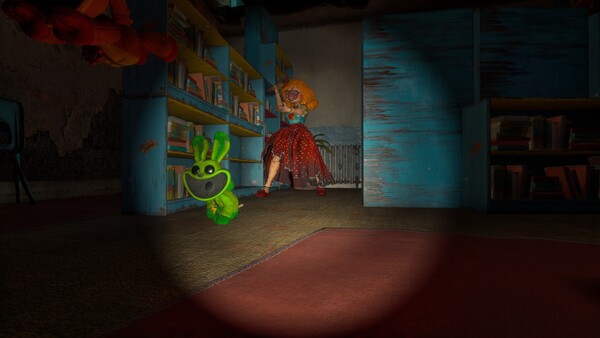
Procedural layouts instead of a fixed map
Mob Entertainment's reveal release describes factory areas that change dynamically, and the current Steam description still says the environments are procedurally generated. Both official sources describe the same intended design from different points in time. Each run rearranges the rooms you explore, so the factory never settles into one shape. That is the single most important thing to know before searching for a map.
This design is the main reason no official floor plan exists for the game. A map drawn from one recording can only show the layout from that particular session. The next run will put rooms in a different order and connect them differently. Studying one layout closely can actually mislead you on the next attempt.
The research behind this page found no downloadable official floor plan, no item coordinates, no full room catalogue and no release-version map screenshot. Any site offering one should explain which build and which run it comes from. Without that context, it is simply a picture of somebody else's game. Treat such maps as curiosities rather than guides.
Factory environment types
The official material names several kinds of space inside the abandoned Playtime Co. factory. These include classrooms, warehouses, testing labs and the corridors that connect them. You will move between these spaces constantly as you collect resources for the Voice. Each type has its own look, which helps you tell where you are.
These names describe environments, not separate launch zones that you unlock in order. The publisher says the initial Early Access release will include one starter zone. More zones are expected during development, but none of them have announced dates. A room type you see in a trailer is not proof of an extra zone at launch.
Knowing the room types is still practical in every run. Telling teammates that you are in a classroom or a testing lab narrows down where they should look for you. It is a simple way to share your position without any map at all. Over time, a team builds a shared vocabulary for the factory.
Why navigation is the real challenge
Because layouts change, finding your way back is a core part of the game rather than a side problem. The developer's October 8 feedback post acknowledges that players found it hard to return to Barry, the loot cart. That post groups navigation with exits and quotas as the areas that confused first-time players most. All three are being reworked before launch.
The small-toy perspective adds to the challenge in a way that maps cannot capture. PC Gamer's preview describes playing as tiny plush animals moving through a factory built at human scale. Traversal and climbing are part of getting from one room to the next. A route that looks short on paper can involve awkward detours.
Scavenging takes you away from Barry, and every load you collect has to come back. A team that loses track of the route wastes time and takes more risks around hostile toys. Good navigation habits therefore matter more than any single shortcut. They are what turn a chaotic run into a successful one.
Glowsticks, beacons and finding Barry
The official beta tips recommend glowsticks for regrouping when teammates become separated. They also help players navigate back toward Barry during a run. Dropping them along a route is the documented way to leave a trail in the October test build. It is the closest thing the beta had to a personal map.
The October 8 post also discusses ping beacons as part of the navigation feedback from players. Treat the beacon discussion as a description of the developer's plans and the community's requests, not as a finished feature list. How beacons work in the release build has not been confirmed. Check it when Early Access arrives.
Thinknoodles' developer-session recording lists a route-marking chapter at 11:08. It is a useful place to see how players handled navigation during the beta with the developers present. The chapter is a viewing point, not a source of map coordinates. No transcript of the video was available for review.
The announced map-type item
In response to player feedback, the developer announced an experimental map-type item in its October 8 post. The announcement is written in the future tense throughout. It describes something planned for the revised build, not a feature that existed during the beta. Nobody outside the studio has tested it yet.
Its final interface and behaviour have not been verified for this page. It may help teams orient themselves within a single run, which would address the problem the developer described. It will not turn a procedurally generated factory into one fixed map that works for every run. Any guide built on it will still need to respect changing layouts.
We will describe the item properly once it can be tested in the Early Access build. Until then, treat any screenshot claiming to show it with caution. Ask which build it was taken from and whether it shows the final interface. Planned features often change before release.
Practical navigation habits
The following is practical advice inferred from the changing layouts, not a guaranteed game mechanic. Pick out landmarks as you move and say them out loud to your team. A broken desk or a distinctive machine is easier to describe than a compass direction. Landmarks you notice yourself beat anything memorised from a video.
Keep one teammate responsible for remembering the way back to Barry. Proximity voice chat means distant players are harder to hear, so the group should not spread out too far. The official FAQ notes there is no in-game text chat to fall back on. If you cannot hear someone, assume they are out of range.
Mark long routes with glowsticks before you need them, not after you are already lost. Return trips are when teams are most likely to be carrying loot and least able to search carefully. A trail laid on the way out pays off on the way back. It also helps a separated teammate rejoin the group.
Using playtest videos as references
Alexbon's four-shift playtest walkthrough is a good comparison reference for the rooms that appeared in that run. Its description indexes the shifts at 00:00, 07:50, 18:50 and 24:10. No transcript or route annotation was available for it. Watch it for atmosphere and room types rather than directions.
One recording cannot establish an authoritative layout, however carefully it is studied. Comparing two or three runs quickly shows how much the arrangement changes between sessions. That variation is exactly what the procedural design intends. It is also why this wiki avoids publishing fixed maps.
After October 21, we will compare Early Access runs and test the new navigation item before publishing anything map-like. If a reliable official map is ever released, we will link it here. Until then, learning to read the factory is the most useful map you can have. Our beginner guide covers the basic loop that every route serves.
Sources and further reading
- Escape from Playtime — Steam store page
- Mob Entertainment announces Escape From Playtime
- Moving Forward Based on Feedback — Steam announcement
- Escape From Playtime is a co-op survival horror where you play toy animals — PC Gamer
- Escape From Playtime Open Beta! — Steam announcement
- I Played ESCAPE FROM PLAYTIME EARLY With DEVS! — Thinknoodles (YouTube)
- Escape From Playtime FAQ — Mob Entertainment
- Escape from Playtime Playtest | Full Walkthrough — Alexbon (YouTube)